Ipamorelin effects, side effects and safety
An unchanged blood marker, altered hormone responses in diabetic mice, and the everyday effects people describe outside trials.
Heart findings from GSK894281
The cardiovascular investigation of GSK894281 deserves its full compound name. This structurally different ghrelin-receptor agonist caused dose-dependent heart-muscle degeneration and necrosis in rats in the 28-day work discussed by the authors. A separate 7-day rat study in the same paper found elevated FABP3 at the highest dose, with cardiac troponins unchanged.
The concern cuts both ways for me. Assigning those lesions to ipamorelin would misidentify the experiment. Dismissing them because they happened to a relative would throw away a reason to investigate chronic receptor stimulation. The published ipamorelin record contains no equivalent long-duration cardiovascular safety study. That leaves a substantial question, especially where heart disease, heart failure or significant edema already exists.
Diabetic-mouse hormone responses
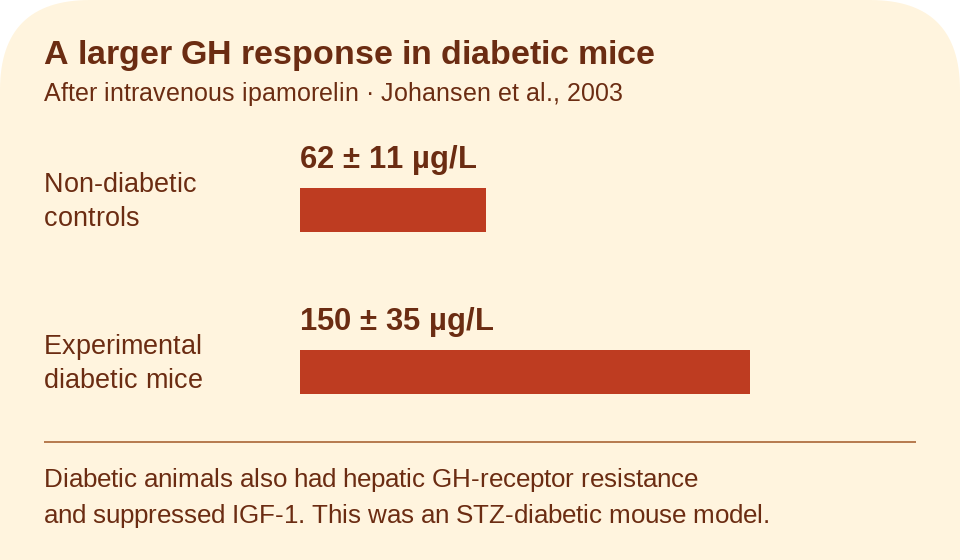
In streptozotocin-diabetic mice given intravenous ipamorelin, the growth-hormone response was 150 ± 35 µg/L, compared with 62 ± 11 µg/L in non-diabetic controls. The diabetic animals also had hepatic growth-hormone-receptor resistance and suppressed IGF-1. This was an experimental diabetic mouse model.
The larger growth-hormone response came with an impaired downstream response. That combination makes the study especially awkward for claims that a bigger pulse necessarily means a better result. Growth hormone can reduce insulin sensitivity, and existing diabetes, impaired glucose tolerance or insulin resistance makes the unresolved net effect on blood sugar particularly relevant. Human glucose outcomes at the research-use doses circulating online remain uncharacterized.
Tumour growth, edema and appetite
Growth hormone can stimulate production of IGF-1, a signal involved in cell growth and survival. That creates a theoretical concern about stimulating an existing or hidden tumour in someone with active or recent cancer or another proliferative condition. Ipamorelin-specific human cancer-risk studies are absent. The rat bone-growth study also reminds me that systemic IGF-1 can remain unchanged even when a tissue response occurs; the biology resists a single-marker explanation.
Excess growth-hormone activity is associated with sodium and water retention, another reason that heart failure or substantial edema matters. The ghrelin-receptor class also participates in appetite and gut function, as the gastrointestinal review describes. Increased appetite or fat deposition could be unwelcome where weight gain is already a concern. These are mechanistic and class-level cautions; their presence supplies no measured probability of harm from ipamorelin in a particular person.
Community accounts
Community reports describe deeper sleep, vivid dreams and faster recovery after training. Others describe a subtly leaner appearance, often while changing diet and training. These are anecdotal accounts, not clinical evidence: the material, other exposures and the expectation of a result can all complicate the story.
The adverse reports deserve the same space. People describe facial flushing or a head rush, tingling or numbness in their hands and feet, puffiness, increased hunger, fatigue, dizziness or a spacey feeling, and local redness, itching or swelling. Some say the perceived response fades with continued use. None of these accounts establishes how often the effect occurs or proves its cause.
These complaints deserve attention; plausibility alone cannot confirm their cause. A flush cannot identify a peptide or verify its purity; a memorable dream supplies no measurement of sleep architecture.
Is CJC-1295 ipamorelin safe?
The combination lacks a controlled human safety trial. Ipamorelin’s published surgical trial covered a short perioperative window of up to 7 days; its human pharmacokinetic study concerned acute intravenous infusions. The CJC-1295 protein-profile paper tested that compound separately. Joining these records cannot establish the safety of joining the compounds.
Research-grade material adds uncertainty about identity, purity and sterility. A selective acute hormone response is a useful property to investigate, and the founding rat-and-swine work supports it. Chronic human safety needs its own evidence.